A dog should never be an impulse purchase. Take your time,
meet the dog and seller in person, check the documents and
walk away whenever something does not feel right.
!
Never pay merely to reserve a dog you have not seen.
Do not transfer money because a seller is applying
pressure, claiming another buyer is waiting or offering
delivery before you have completed your checks.
Your safe buying journey
Six checks before bringing a dog home
Take each stage in order. A responsible purchase should
never depend on rushing, pressure or skipping important
checks.
⌕1. Research
Breed, costs, seller and advert.
✉2. Ask
Age, history, health and breeder.
⌂3. Visit
Meet the dog where it lives.
✓4. Verify
Microchip, records and documents.
♥5. Decide
Take your time and never be pressured.
!6. Report
Stop and report suspicious activity.
1
Before contacting a seller
Research the breed, likely costs and the seller before
arranging a visit.
Check whether the breed suits your home, working hours,
children, other animals and long-term budget.
Read the complete advert and compare it with other adverts
for inconsistencies, copied text or unusually low prices.
Review the seller’s profile, account history, verification
indicators and previous adverts.
Ask why the dog is being sold or rehomed and who bred the
dog.
Confirm the dog’s exact age, date of birth, sex, health
history and current location.
Ask commercial breeders or sellers for their local-authority
licence number and the issuing council.
🐶
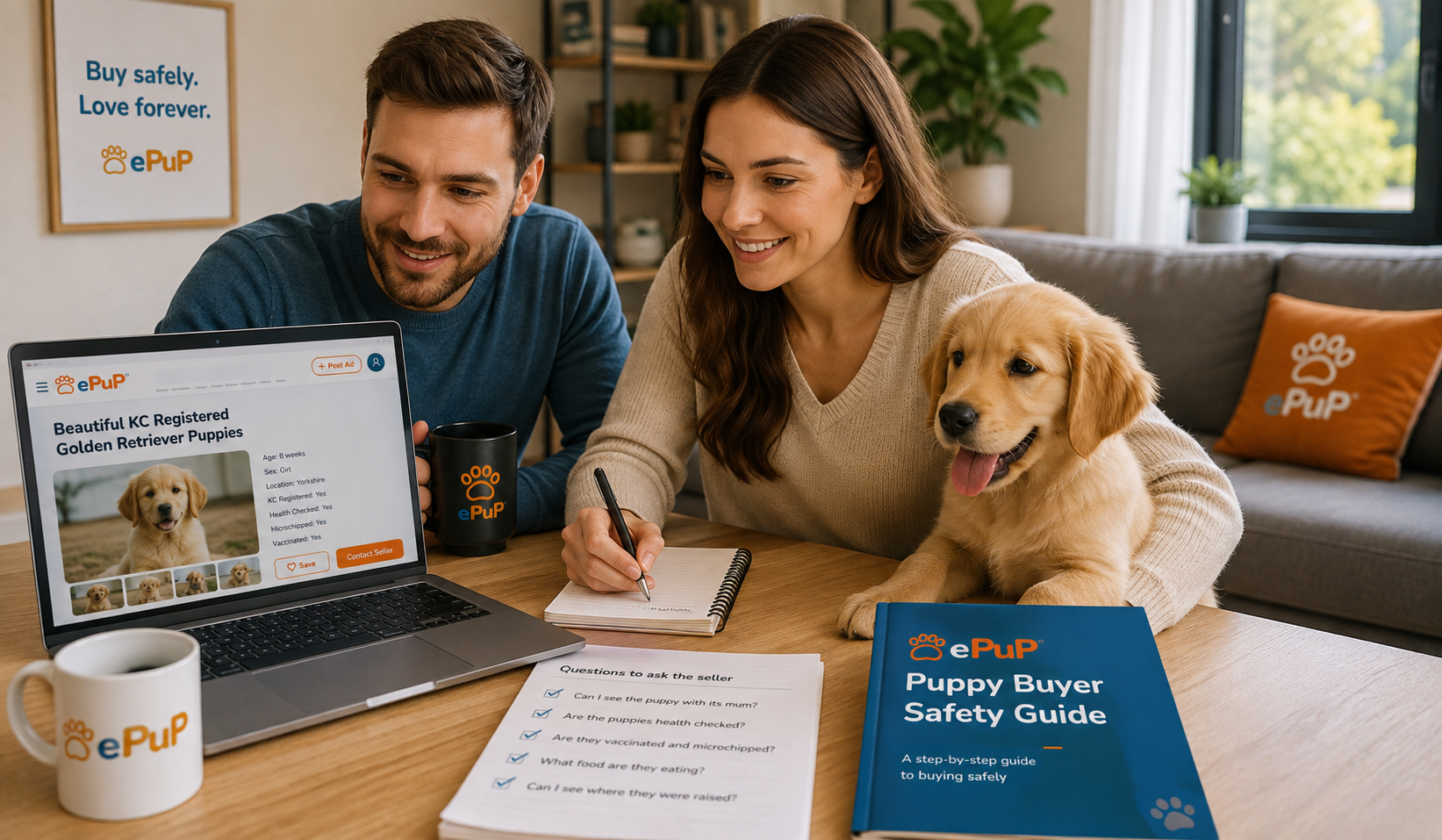
Future ePuP artwork: preparing to buy a puppy
Reserved for a premium branded illustration showing a
buyer researching a puppy, checking an advert and
preparing questions before contacting the seller.
/assets/images/safety/buying-safely.jpg
2
Meet the dog where it lives
A genuine seller should be comfortable allowing a
careful, unhurried visit.
Visit the seller’s home or licensed premises. Do not agree
to meet in a car park, roadside location or service station.
For a puppy, see it interacting naturally with its
biological mother and littermates where it was bred.
Check that the mother appears comfortable with the puppies
and is not simply another dog presented as the mother.
Observe the dog’s breathing, eyes, nose, coat, movement,
behaviour and living conditions.
Do not accept doorstep delivery or courier delivery as a
substitute for visiting and completing your checks.
Consider taking another adult and tell someone where you
are going. Leave if you feel unsafe or pressured.
Puppies must be old enough to leave.
Do not purchase or collect a puppy below eight weeks old.
🏠
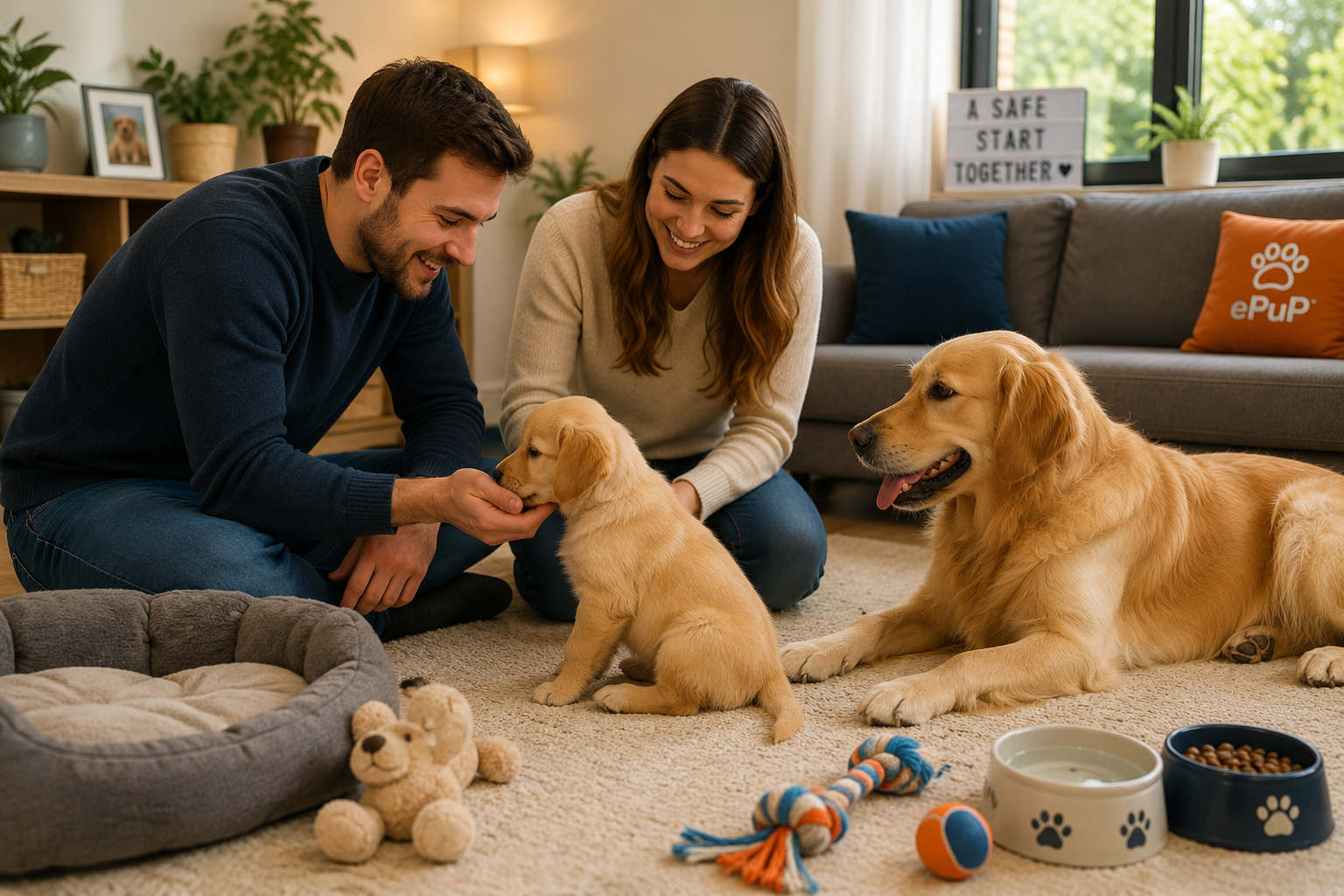
Future ePuP artwork: meeting the puppy at home
Reserved for a natural home scene showing a prospective
owner meeting a puppy with its mother and littermates
in the environment where it has been raised.
/assets/images/safety/meet-puppy-and-mother.jpg
3
Check records independently
A photograph of a certificate is not the same as an
independently verified record.
Microchip
Confirm the microchip number and arrange for it to
be scanned. Make sure the seller’s details match the
registered keeper or breeder information.
Veterinary history
Review vaccination, worming, flea-treatment and
veterinary records. Contact the veterinary practice
independently when appropriate.
Breed health tests
Ask for the original results relevant to the breed
and check the identity of the tested parents.
Licence details
Where a licence is required, verify the licence
number with the council that issued it rather than
relying only on the advert.
Written agreement
Ensure the receipt or contract records both parties,
the dog’s details, price, microchip number and any
agreed health or return terms.
4
Standards expected from sellers
Anyone advertising on ePuP is responsible for complying
with the law that applies to them.
Advert information and photographs must be accurate,
current and relate to the dog actually being offered.
Sellers must disclose known health, behavioural, ownership
and welfare information that could affect a buyer’s
decision.
Puppies must not be advertised as ready to leave before
reaching the legal minimum age.
Sellers must not disguise commercial activity as a private
rehoming arrangement or use another person’s identity.
Where licensing applies, the seller must hold a valid
licence and provide accurate licence information.
Sellers must not pressure buyers, request misleading fees
or attempt to move communications off-platform to avoid
safety controls.
Different rules apply across the UK.
Sellers must check the current requirements in England,
Scotland, Wales or Northern Ireland and contact their local
authority where uncertain.
5
Stop when you see warning signs
One concern may have an innocent explanation. Several
concerns together should make you walk away.
The seller refuses a home visit, will only deliver or
repeatedly changes the meeting address.
The same telephone number, photographs or wording appears
in adverts for many breeds or locations.
The seller cannot show the puppy with its biological mother
or gives changing explanations about her absence.
Payment is demanded urgently by bank transfer, gift card,
cryptocurrency or an unfamiliar payment service.
Documents contain different names, dates, addresses,
microchip numbers or veterinary practices.
The seller avoids normal questions, discourages a vet
inspection or offers a discount for immediate collection.
The puppy appears very young, unwell, frightened, poorly
socialised or is being kept in unsuitable conditions.
The seller asks you to misdescribe the payment or claims
ePuP guarantees, holds or insures money when it does not.
🔎
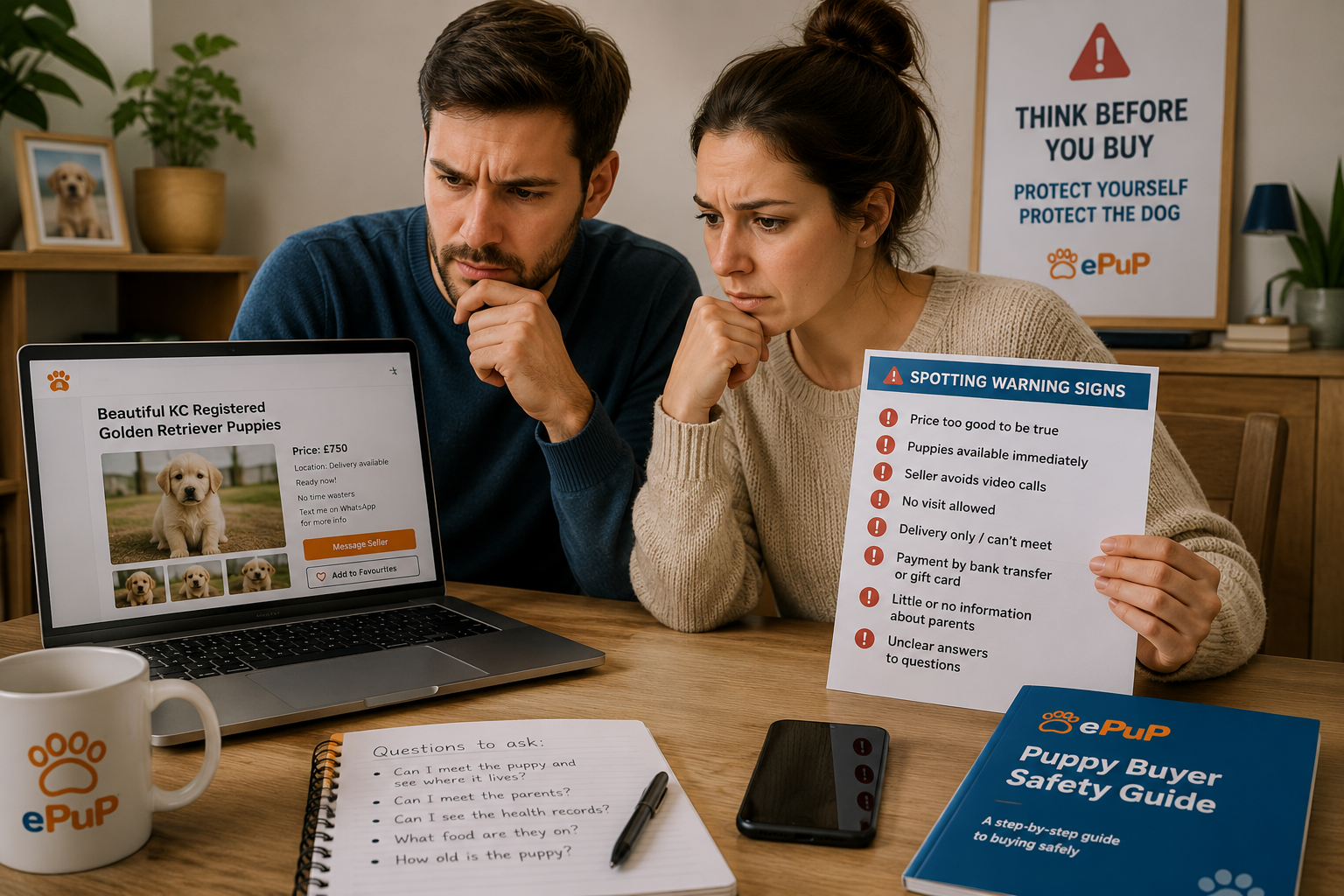
Future ePuP artwork: spotting warning signs
Reserved for a clean ePuP safety illustration showing
advert checks, identity and document verification,
suspicious payment requests and scam warning signals.
/assets/images/safety/spot-the-warning-signs.jpg
6
Payments, scams and verification
Treat payment as the final stage of your checks, not the
first step in securing a dog.
Keep control of the transaction
Do not send money simply because somebody says a puppy
is popular, another buyer is waiting or a deposit must
be paid immediately. Complete your checks first and
make sure you understand exactly who you are paying.
Be cautious with reservation payments
A reservation fee can be difficult to recover. Never
treat a payment request, invoice, screenshot or bank
account name as proof that the seller, dog or advert is
genuine.
Check the payee
Compare the seller's name, contact details, address,
licence information and payment details. Unexpected
changes to a bank account or instructions to pay another
person should be investigated before proceeding.
Keep evidence
Retain advert details, ePuP messages, receipts,
contracts, seller information and payment records.
These can be important if a dispute, welfare concern or
suspected fraud is reported later.
Never do these things because a seller pressures you
Pay for a dog you have not properly seen and checked.
Send gift cards, cryptocurrency or money through an
unfamiliar service simply because the seller requests it.
Describe a payment dishonestly or mark it as something
unrelated to the dog.
Ignore a bank warning, mismatched payee name or sudden
change of payment details.
Believe a claim that ePuP is holding, guaranteeing or
insuring your money unless that service is explicitly
shown and confirmed by ePuP itself.
Understand what ePuP verification means
Verification features can help users assess an account, but
no badge removes the need for your own checks. Different
checks confirm different pieces of information.
Identity or account checks
Can indicate that certain account information has
been checked. They are not a guarantee of honesty,
legal compliance or the condition of a dog.
Phone or contact verification
Shows that a contact method has been verified at a
point in time. It does not prove ownership of a dog,
breeder status or trading legitimacy.
Licence information
Where licensing applies, independently confirm the
licence number and issuing authority rather than
relying solely on an advert or profile badge.
✓
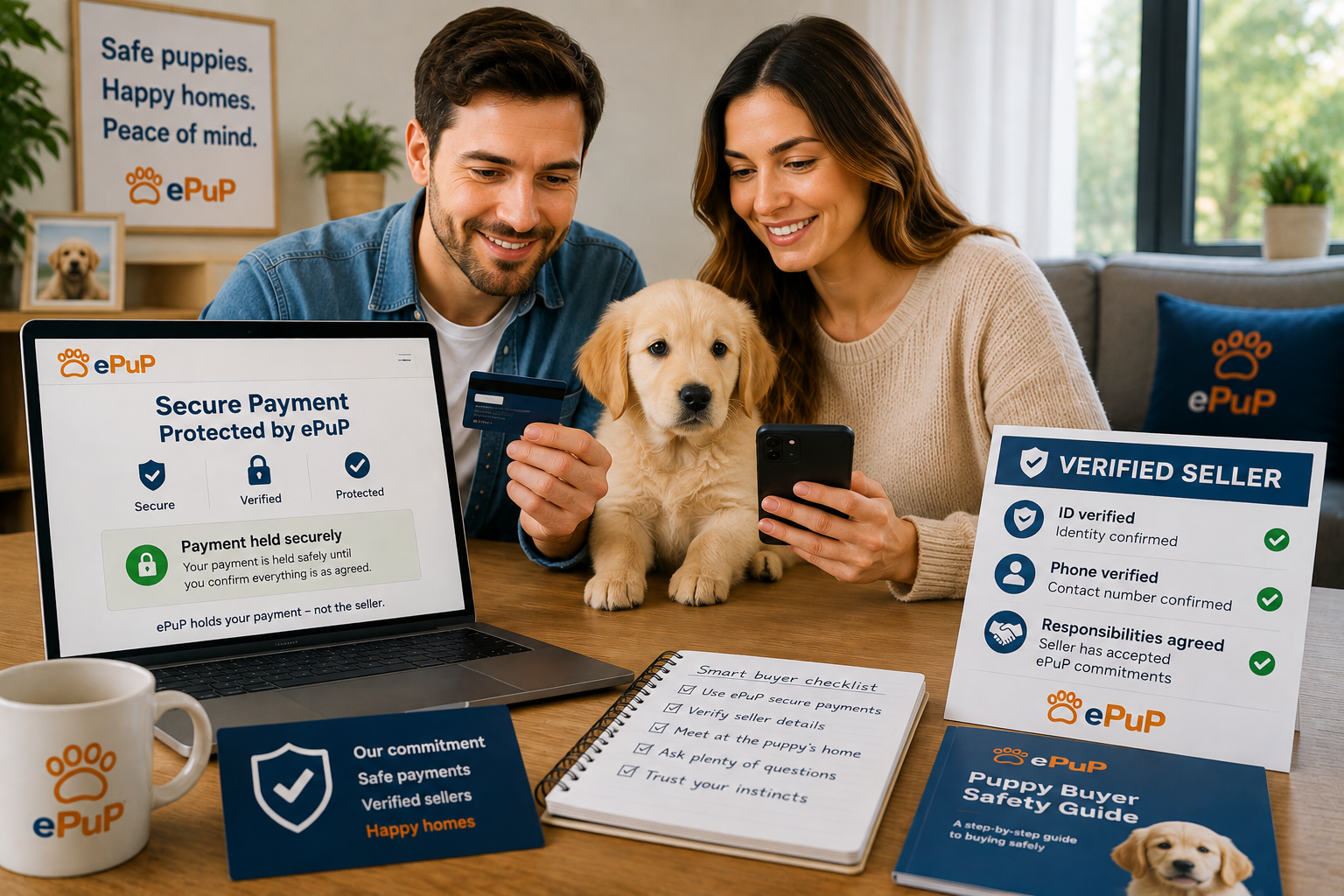
Future ePuP artwork: safe payments and verification
Reserved for a premium ePuP illustration showing seller
verification, account checks, payment details and safe
transaction decisions.
Safe buying does not end at collection. Keep records,
complete the essential ownership steps and pay close
attention to your dog during the first days and weeks.
Arrange a veterinary check
Register with a veterinary practice and arrange an
initial health examination promptly, even when the dog
appears healthy. Take vaccination, worming, microchip
and health-test records with you.
Transfer the microchip details
Make sure the registered keeper information is updated
through the relevant microchip database and keep the
confirmation with your ownership records.
Keep every document
Retain the advert, messages, receipt or contract,
payment record, licence information, health documents
and any written promises made by the seller.
Consider suitable insurance
Review pet-insurance options carefully, including
exclusions, excesses, waiting periods and cover for
hereditary or pre-existing conditions.
Allow time to settle
Keep the first few days calm and predictable. Introduce
family members, other pets, new environments and
training gradually rather than overwhelming the dog.
Monitor health and behaviour
Watch appetite, drinking, toileting, breathing,
movement, sleep, energy levels and behaviour. Seek
veterinary advice promptly if anything concerns you.
If your new dog becomes unwell soon after purchase, act quickly.
Contact a veterinary professional, preserve all documents and
communications, and notify the seller in writing. Do not delay
urgent veterinary care while waiting for a seller to respond.
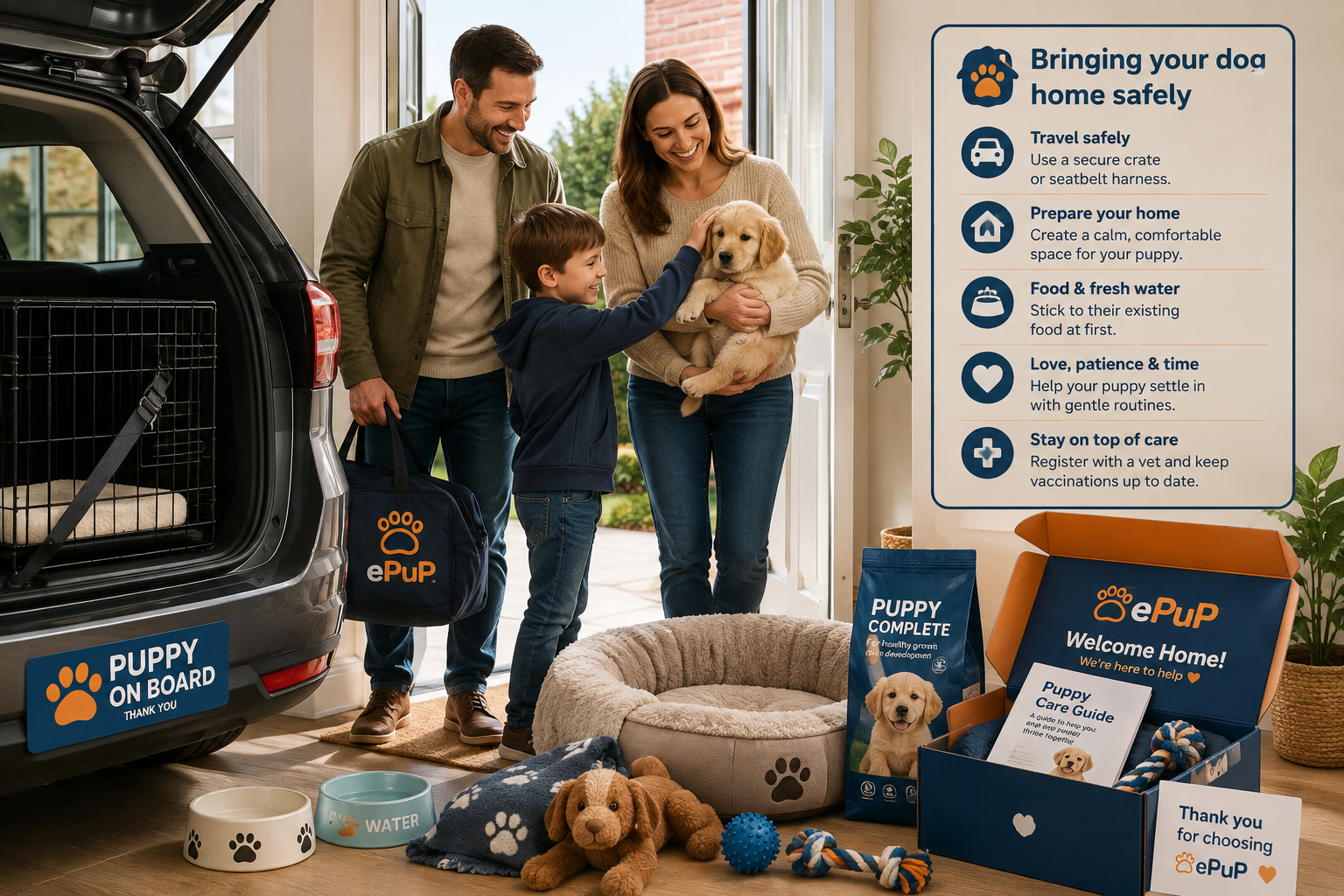
🏡
Future ePuP artwork: bringing your dog home safely
Reserved for a warm premium ePuP illustration showing a
new dog settling into a calm home, with veterinary
records, microchip details and responsible aftercare.
/assets/images/safety/bringing-your-dog-home.jpg
8
Report concerns promptly
Preserve messages, payment details, advert screenshots
and other evidence.
Suspicious ePuP advert
Use the report control on the relevant advert. Do not
confront a seller where doing so could put you or an
animal at risk.
Do not let excitement replace careful checks.
Before completing the transaction, make sure you
are comfortable with every point below.
✓
I have met the dog in person
I have visited the place where the dog
currently lives and have not relied only
on photographs or video.
✓
I have seen the mother where relevant
For a young puppy, I have seen it naturally
interacting with its biological mother in
the environment where it was raised.
✓
I am satisfied with the seller
Their identity, contact details, story and
answers are consistent and I have not been
pressured into making a decision.
✓
The microchip details have been checked
I know the microchip number and understand
how ownership or keeper details will be
transferred after collection.
✓
I have reviewed the health records
Vaccination, veterinary, treatment and
relevant breed-health information have been
shown and make sense.
✓
Licence information checks out
Where licensing is required, I have checked
the licence information rather than relying
solely on what appears in the advert.
✓
The payment arrangement feels safe
There are no unexplained urgent deposits,
unusual payment requests or claims that
ePuP is holding or guaranteeing my money.
✓
I will receive written paperwork
The receipt or agreement records the dog,
seller, buyer, price, microchip and any
agreed health or return terms.
✓
The dog appears healthy and comfortable
I have observed its breathing, movement,
behaviour, eyes, coat and general condition
and will seek veterinary advice where needed.
✓
My home and journey are prepared
I have suitable transport, food, bedding,
identification arrangements and a calm place
ready for the dog's arrival.
If you cannot confidently tick every relevant box, stop.
A genuine seller should understand that responsible buyers
need time to complete proper checks.
🐶
Pug AIYour ePuP assistant
Hi! I'm Pug AI 👋
I can help you find a puppy, improve an advert, understand breeds, or use ePuP safely.
YOUR PRIVACY
Cookies on ePuP
We use strictly necessary cookies to keep ePuP secure and working.
With your permission, we may also use functional, analytics and
marketing cookies to improve the marketplace.